19/10/2024
What Was the 2024 Intergenerational Meeting Like
ČSH
From Friday 11 October to Sunday 13 October 2024, the tenth edition of our largest annual event took place in Jihlava — the popular Intergenerational Meeting, organised by the Czech Hemophilia Society together with Hemojunior.
Interest was high, as evidenced by nearly 120 participants this year. The programme was truly packed.
On Friday evening, we gathered for a presentation of the results of a workshop that had taken place at the same venue a month earlier, attended by 15 patient representatives from all categories. The outcome is an identification of the most important areas where patients with bleeding disorders in our country experience gaps, along with an action plan for gradually addressing these shortcomings. More detailed information presented to the meeting participants will be covered in a separate article.
The chairpersons of both organisations — the Czech Hemophilia Society and Hemojunior — presented brief reviews of the past period, including upcoming events and the involvement of additional members in illuminating buildings for World Haemophilia Day (17 April). A list of cities was prepared behind the scenes, where interested individuals could sign up for a specific city.
The highlight of Friday evening was the presentation of the Czech Hemophilia Society Annual Award, which for 2023 was given to Mr Petr Slunský. We recognised his long-standing work for the society, which he has been part of since its very beginnings, and for the entire haemophilia community.
The Saturday programme was opened by physiotherapist Bc. Lenka Tichá, who presented the podoscope examination and its benefits. Participants could try this out in practice at the afternoon workshop.
This was followed by a talk by Bc. Pavel Kraus, who specialises in physical activities and training plans for people with health conditions. He emphasised the importance of exercise as a key prerequisite for living to an older age in the best possible condition. He also presented the possibilities of modern fitness centres. During the afternoon workshop, interested attendees could immediately stretch their bodies with practical exercise demonstrations.
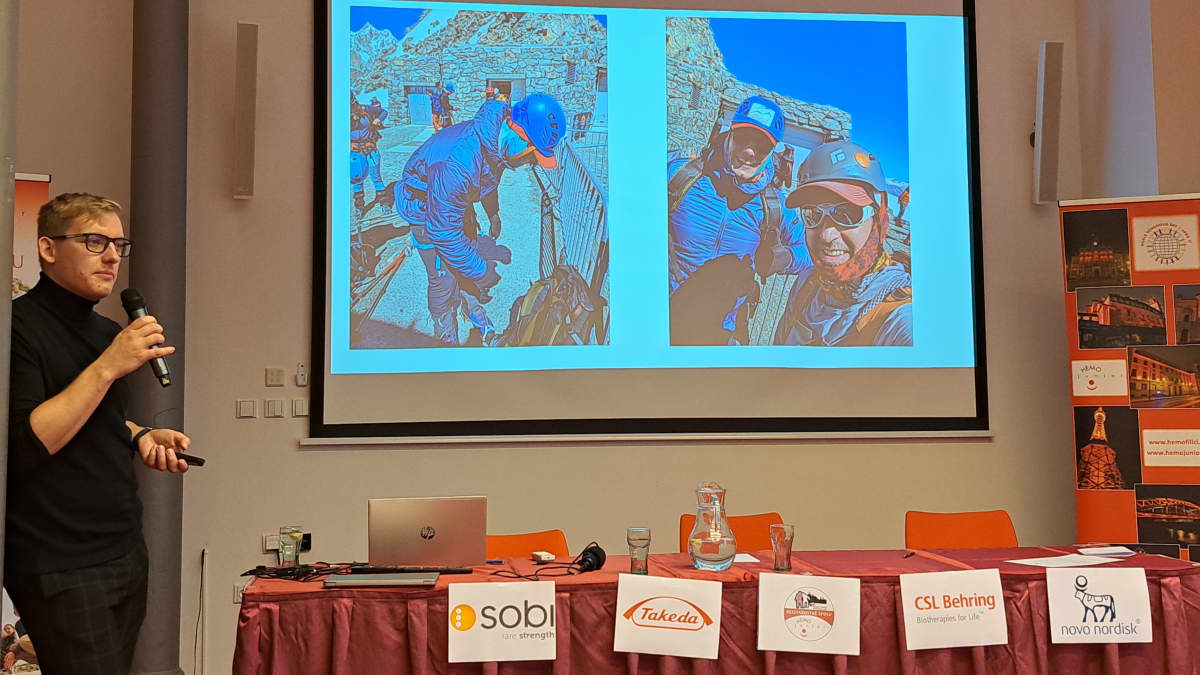
In the next presentation, Daniel Šimek shared his experiences and many photographs from the Mont Blanc expedition, which he undertook this year with an international group of haemophilia patients. The expedition aimed to support projects in less developed countries through the Save One Life organisation. Dan received a roaring applause from the entire audience for his presentation and achievement.
MUDr. Irena Čápová presented the care options for haemophilia patients at the new haemophilia centre at Nymburk Hospital. Everyone was certainly impressed not only by the modern treatment options but also by the mention of the hospital kitchen, which is managed by a head chef with experience from Michelin-starred restaurants. Through the doctor, we sent printed educational materials, including information leaflets, to the new centre.
The morning session was concluded with a talk on cold water exposure by the vice-chairman of the Czech Hemophilia Society, Martin Žídek.
The afternoon was opened by Ms Michaela Tůmová with a talk on self-examination for both men and women as an important part of cancer prevention.
The afternoon continued with two blocks of workshops, where in addition to the two mentioned above, interested attendees could also take advantage of individual consultations with psychologist Mgr. Petra Bučková or physiotherapist Mgr. Marie Katzerová.
The afternoon concluded with a teleconference with Mr Brian O'Mahony from Ireland. He is not only a former president of the World Federation of Hemophilia and a long-standing member of the Irish patient organisation leadership, but above all, as one of the first patients with haemophilia B, he underwent gene therapy four years ago. During his presentation, he shared his experiences with this type of treatment remotely and answered many questions from the audience.
After dinner, Doc. MUDr. Jan Blatný, Ph.D., spoke about the latest developments in the treatment of haemophilia and von Willebrand disease. No one in the audience was left in any doubt that the rapid developments in treatment that we have witnessed over the past ten years are far from over.
On Sunday after breakfast, the programme was concluded by neurologist MUDr. Petr Hollý from the General University Hospital in Prague, together with MUDr. Radomíra Hrdličková from the University Hospital Ostrava, who spoke about experiences with treating acute cerebrovascular events in haemophilia patients. According to their experience, current haematological treatment options give a good prognosis even for these patients. However, the most important thing is prevention, both in the form of a healthy lifestyle and in the form of well-established haematological prophylaxis.
Throughout the entire Saturday programme, the younger generation of participants was well looked after. Right after breakfast, they set off with two educators to the local underground and museum. The Jihlava catacomb system, with an area of 50,000 m² and a length of about 25 km, is the second largest in the Czech Republic after the Znojmo underground. After returning in the morning, everyone could spend time in the designated hotel space, in the company of their peers with various arts and crafts activities, games, or creating a "haemophilia" Kahoot. This could help with disease awareness as part of World Haemophilia Day and further education. We would like to thank Bc. Michaela Janošková and Mgr. Jiří Salajka for taking care of the children and also for their valuable insights and advice that can help us prepare the programme for next year.
Although this edition was one of the most demanding in terms of the number of speakers and topics, the initial feedback from participants on site confirmed that they certainly did not regret the time or energy invested in the event. As organisers, we have set the bar for next year's edition quite high, but we already believe we will manage to surpass it.
The event was made possible thanks to the generous financial support of Takeda, SOBI, CSL Behring, and Novo Nordisk. We would like to thank them.


