26/04/2018
The Regional Workshop Project Reports Another First
ČSH
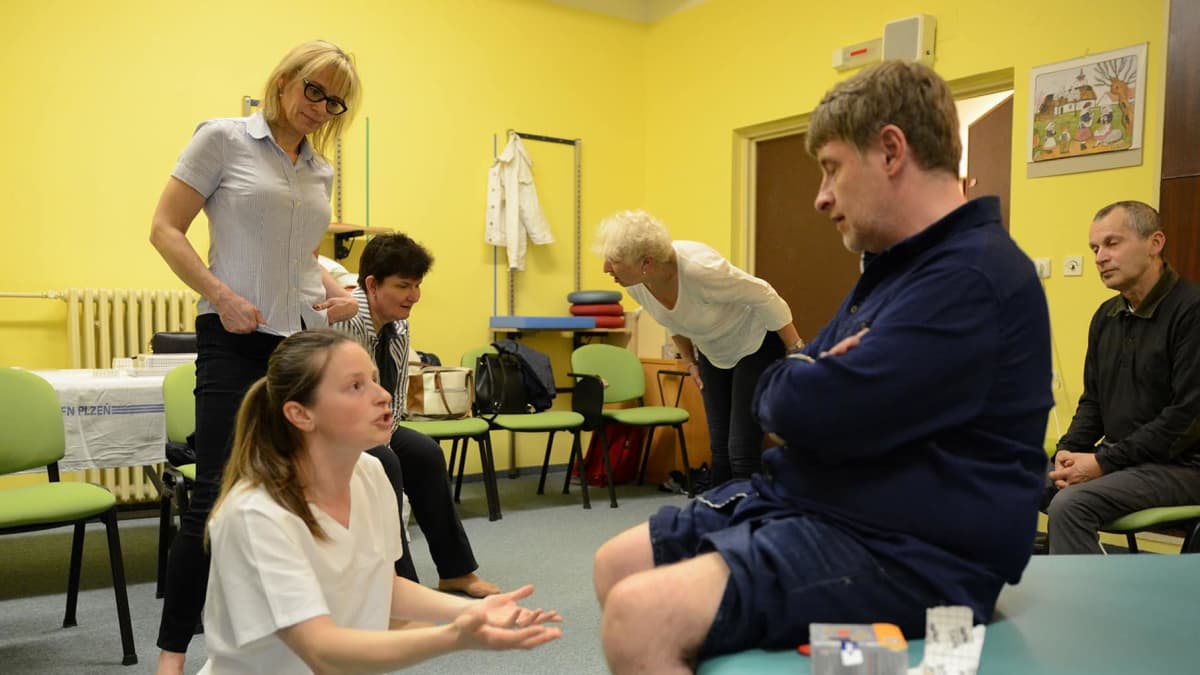
It started first on Saturday 14 April with a rehabilitation-themed seminar in Plzeň, and three days later, on World Hemophilia Day, we continued in Hradec Králové. At the close of April, which has traditionally belonged to hemophilia patients, we would like to look back on these two workshops. And with whom else but the participants themselves? Two of them shared their impressions with us, and we present their observations in the following lines.
I attended an excellent event.
The mini-workshop in Plzeň with a rehabilitation theme, called "We Enjoy Living", was organized on 14 April 2018 on the occasion of World Hemophilia Day. The main topic was acute and chronic pain and the possibilities of managing it through rehabilitation techniques. Rehabilitation methods suitable for managing acute or chronic pain in ankles, knees, and other weight-bearing joints were presented by physiotherapist Martin Mužíček from the Institute of Hematology and Blood Transfusion. This was followed by a practical session in the rehabilitation department of the University Hospital, where hemophilia patients took turns in two groups - one exercised under the guidance of physiotherapist Dana Vacková in the pool, while the other group listened to the principles of kinesiology taping in the gym, presented by Romana Kunová. Thanks also go to Mrs. Gabriela Sršňová, who came from Prague to share her own lay but valuable experience gathered from taping acute sports injuries of her hemophiliac son. Without the sponsorship of pharmaceutical companies, this event probably could not have been so successful.
What struck me most was the feeling that this was a good family event. Not because of the number of participants, but because of the pleasant atmosphere that prevailed. You cannot plan that. Either a sense of ease radiates from people, or it does not. Someone must have planted this sense of ease.
Therefore, the biggest thanks go to the person who conceived this event, set it in motion, and thereby became the soul and backbone of the entire meeting - MUDr. Zdeňka Hajšmanová.
Thanks also to the event "We Enjoy Living", we enjoy living.
Bedřich Smrčka
1st Regional Meeting of Hemophilia Patients in the Hradec Králové Region from a Patient's Perspective
We finally got one in our region too, in the Hradec Králové Region. Thanks to doc. MUDr. Petr Dulíček from the 4th Department of Internal Medicine - Hematology at the University Hospital in Hradec Králové, the Czech Hemophilia Society, and sponsors, the first regional meeting of hemophilia patients was held at the Teaching Center of the local university hospital on 17 April.
After reading the programme, it was already clear that a packed event with very interesting information awaited us, which was soon confirmed.
After the opening welcome by doc. Pavel Žák, Head of the 4th Department of Internal Medicine - Hematology, doc. Dulíček reminded us of the history of hemophilia treatment at the University Hospital in Hradec Králové. Some of us reminisced about our childhood and youth, and names such as prof. MUDr. Chrobák or MUDr. Mirová, weeks and months spent in hospital wards, litres of blood plasma or cryoprotein, the allergic reactions associated with them - in short, everything that from today's perspective seems like ancient and distant history.
MUDr. Ivanová in her lecture acquainted us with new directions in hemophilia treatment, particularly the development of extended half-life products and the mechanisms by which this effect is achieved. Her lecture also included information about progress in gene therapy development, a field whose results I have been looking forward to for certainly 30 years. Although MUDr. Ivanová's words sounded very positive, it is clear that this is still music of the future.
MUDr. Fiedlerová addressed the unpleasant topic of hepatitis C in hemophilia patients. New cases of transmission in hemophilia patients are fortunately a thing of the past.
The activities of the Czech Hemophilia Society in recent years were presented to the audience by CSH Board member Mgr. Skořepa. Another Board member, Mgr. Koblasa, informed us about the current situation regarding the introduction of uniform identification items for hemophilia patients in relation to paramedics and emergency medicine. All negotiations have progressed and by the summer of this year we could have uniform bracelets on our wrists. Both gentlemen and of course the other Board members of the Czech Hemophilia Society deserve thanks for their work and activity.
Mgr. Katzerová devoted her lecture to physiotherapy for hemophilia patients, an often neglected activity. From my own experience I know that the worst thing is when a hemophilia patient succumbs to their problems and stops exercising.
MUDr. Hak focused his lecture on pharmacokinetics in hemophilia treatment. This was also extremely interesting information, especially for patients on prophylactic treatment. In many cases, unwanted bleeding episodes can be eliminated by properly scheduling prophylactic dose applications in relation to physical activity during the week. For example, it is pointless to administer a prophylactic dose at the end of the day when, "fully pumped with factor," all that awaits us is a night pleasantly spent in bed.
In conclusion, doc. Dulíček introduced two new drugs - Alprolix (hemophilia B) and Elocta (hemophilia A). Both are extended half-life products. Both drugs are in the registration phase with the State Institute for Drug Control, with completion expected by the end of this year. From my perspective, having one injection per week in prophylactic treatment instead of the current two is yet another step forward.
After such an intense flow of information, coffee, sandwiches, pastries, and other refreshments that the organizers had prepared for the audience were very welcome, followed by the practical part of the programme, which included individual consultations with the experts present on treatment, rehabilitation, product administration, hemophilia identification items, and anything else related to hemophilia.
The entire afternoon was concluded with a vernissage of paintings from the Náchod AMAG studio. If I were to evaluate this event as a patient, I have only positives. Based on the programme received, I expected interesting information, and I received it in abundance. The only negative I might have is this: Perhaps the beautiful warm and sunny April afternoon was the reason for the lower attendance from the patient segment of those who have something in common with hemophilia, which is a great shame especially for those patients.
Michal Papoušek